Automation Hub • MNQ/NQ Bot Overview
Elev8+ MNQ/NQ Automated Trading Bot: A Compounding Engine for Nasdaq Futures
Most people lose money trading because execution is inconsistent—hesitation, revenge trading, sizing mistakes, and emotional decision-making. The Elev8+ MNQ/NQ Trading Bot is built to solve that problem: it runs a structured, rules-based process, triggers at a fixed NY-open window, and routes trades from TradingView to your broker automatically through PickMyTrade.
Bottom Line
This is designed to behave like a disciplined, repeatable “automatic money manager” for MNQ/NQ—focused on long-term compounding rather than daily entertainment. It aims to capture meaningful Nasdaq moves while limiting decision frequency and reducing human error.
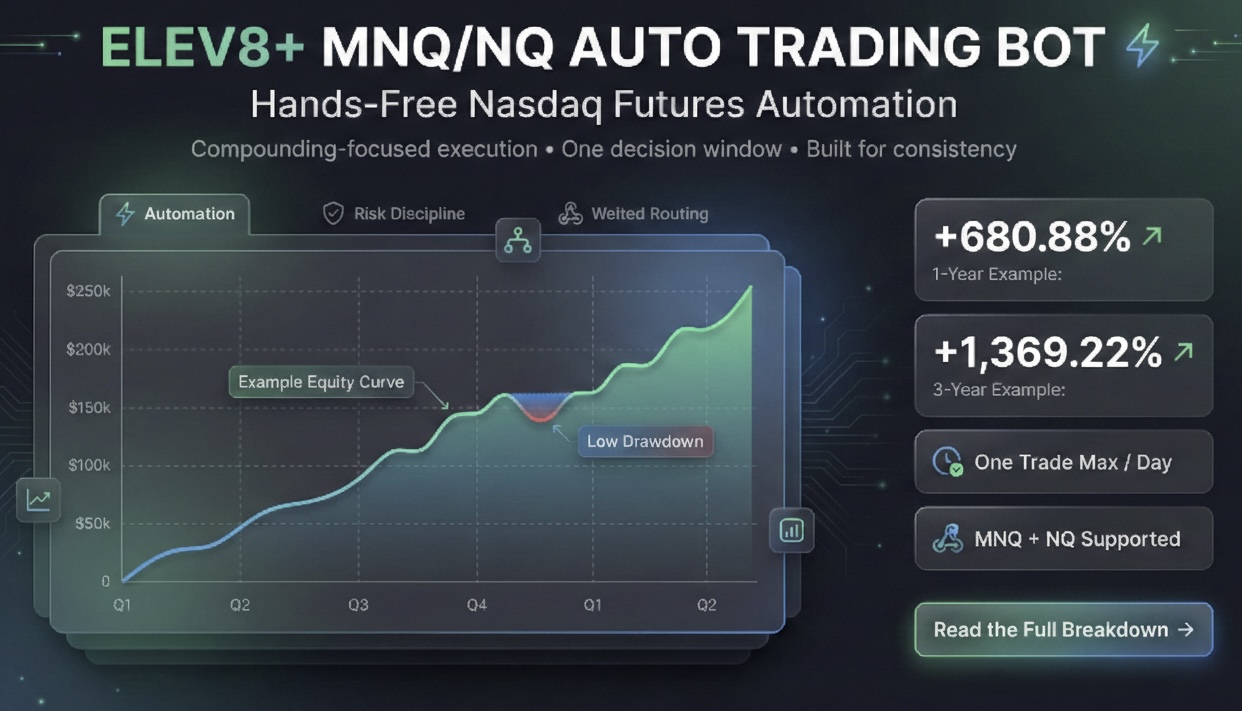
In the past, the strategy has produced periods of exceptionally high returns (including results that have approached or exceeded 500%+ in a year), which can materially outperform typical passive investment targets. Future results can vary, and there will be drawdowns—so the key is correct sizing, realistic expectations, and patience.
Educational content only. Futures trading involves substantial risk and is not suitable for all investors. Past performance is not indicative of future results. Automated systems can fail due to platform outages, connectivity issues, configuration mistakes, slippage, spreads, exchange halts, or extreme market conditions. You are responsible for your own risk, sizing, and compliance with broker/prop firm rules. Never trade money you cannot afford to lose.
Important: Read Before You Start
Automation is powerful, but only if it is configured correctly. If you want a 1-on-1 onboarding session to verify your TradingView alert, PickMyTrade routing, and (optional) TradeSyncer copy trading, contact support before going live.
Free 1-on-1 onboarding video session: We include a free 1-on-1 onboarding call (video) to help you set everything up correctly before you begin—so even if you are not experienced, you will have guided support to confirm your automation is working.
Required Monthly Subscriptions (Cannot Be Avoided)
- TradingView: You need alerts + webhooks available on your plan (automation depends on this).
- CME Live Data: TradingView requires the CME real-time data add-on (commonly ~$7/month) for timely execution.
- PickMyTrade: Required to route TradingView webhook orders to your broker/prop firm connection.
- TradeSyncer (Optional): Only needed if you want copy trading across multiple accounts.
These are third-party services billed separately from Elev8+. The bot is designed to work with them because they provide the most reliable “TradingView → broker” automation pipeline currently available.
What You Get
- Rules-based execution (removes emotion)
- Server-side alerts (runs even if laptop is closed)
- Defined routine (one structured decision window)
Key Principle
- Automation requires drawdown capacity.
- Scaling must be earned (not forced).
- Compounding works best with patience.
Why It Converts
- Most “passive” investments target ~5–15% annually.
- This system has historically achieved far more in strong periods.
- Your upside expands as you compound + scale contracts.
How the Bot Works (Clear Explanation Without Revealing Proprietary Logic)
The Elev8+ MNQ/NQ Bot is not a “random signal generator.” It is an execution engine that evaluates structured market context around the NY open and produces a deterministic decision: BUY, SELL, or NO TRADE.
The goal is not to trade constantly. The goal is to take only the highest-quality conditions and let expectancy play out over time. This is why automation works: it removes the two things that usually destroy performance—inconsistency and emotion.
1) TradingView Runs the Logic
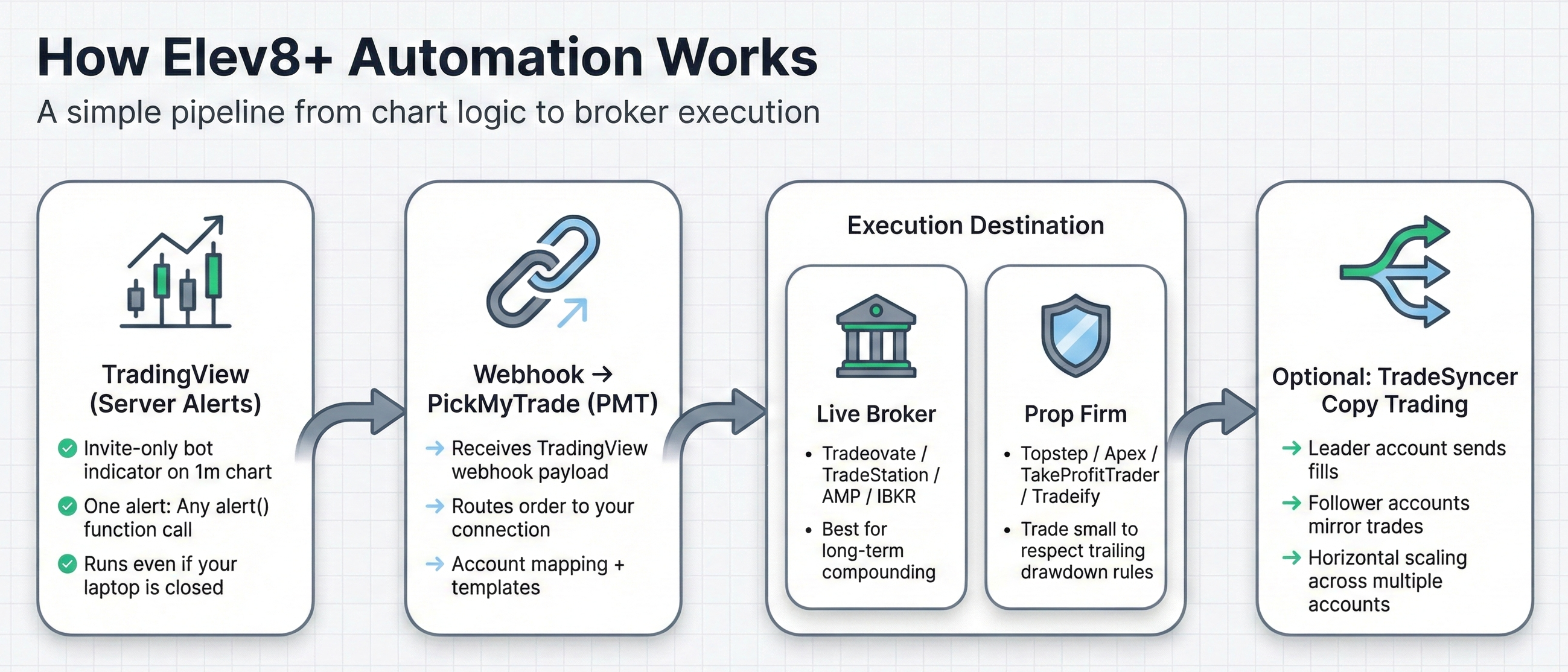
- You add the invite-only bot indicator to a 1-minute chart (MNQ1! or NQ1!).
- You create one TradingView alert using Any alert() function call.
- TradingView then executes the alert server-side at the decision window.
2) PickMyTrade Routes the Order
- PickMyTrade is the bridge between TradingView webhooks and your broker connection.
- You paste your PMT webhook into TradingView and map your account ID.
- When the alert fires, PMT routes the order automatically.
3) One Trade Max (By Design)
- Controlled frequency improves stability and reduces “death by a thousand cuts.”
- This also keeps the system aligned with many prop firm behavior expectations.
- Less screen time. More consistency.
4) Defined Risk Behavior
- The strategy is designed around defined risk boundaries and a consistent exit process.
- Do not add extra “risk rules” that fight the model unless instructed.
- Your job is sizing + funding + keeping the automation pipeline healthy.
How It Looks on the Chart
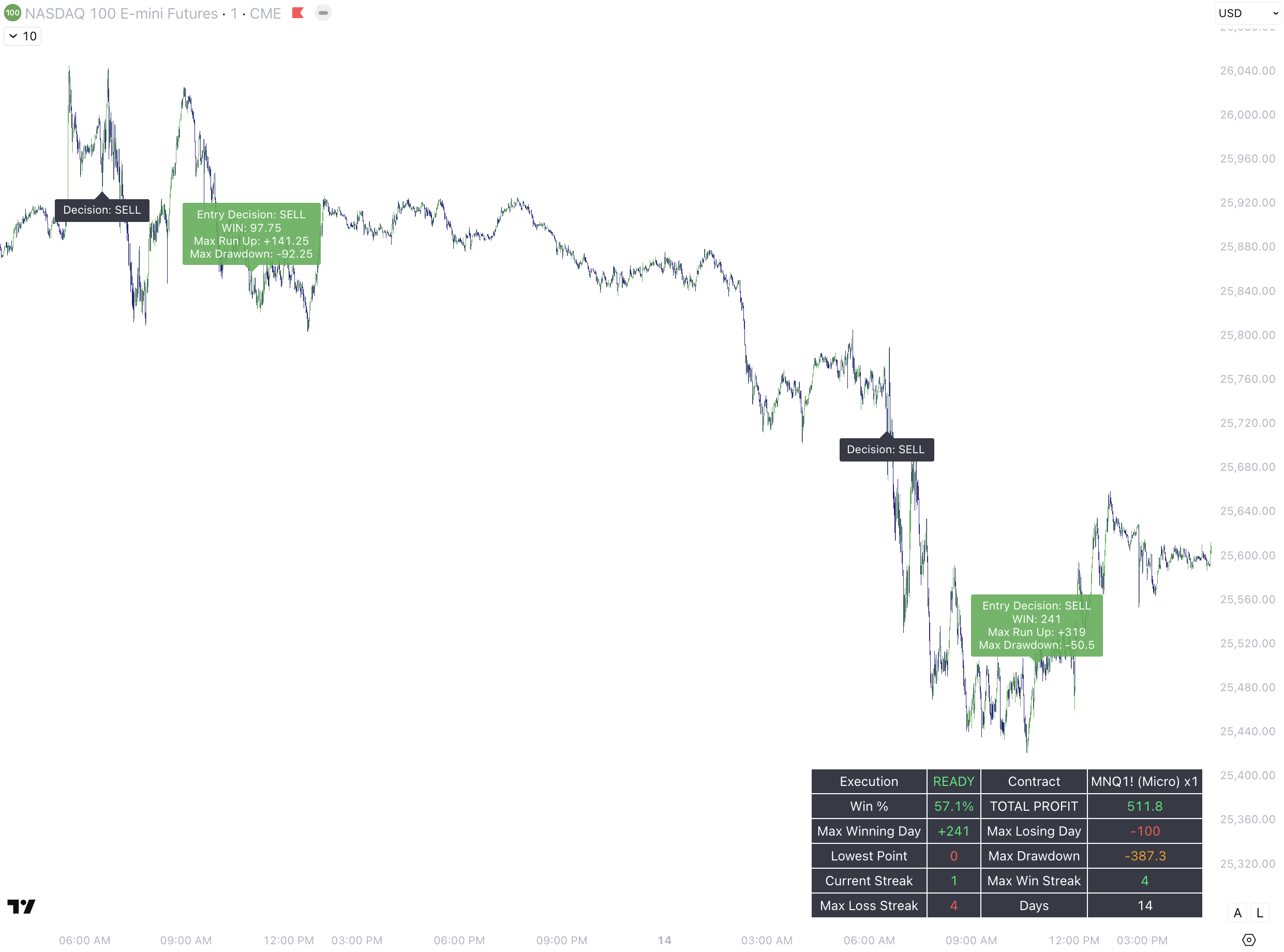
This screenshot shows the bot running on a 1-minute MNQ/NQ chart with the Audit Dashboard enabled and the entry/exit decision tags visible. The purpose is to make the experience simple: you can visually confirm the bot’s decision, the execution state, and the historical audit metrics without needing trading experience or manual interpretation.
What You’re Seeing
- Entry marker + decision tag: BUY / SELL / NO TRADE at the fixed decision window.
- Exit tag: the modeled close event when the system exits the position.
- Audit Dashboard: win %, total points, max drawdown, streaks, and execution readiness.
- Execution status: confirms token/account settings are present before routing.
Screenshot shown for illustrative purposes. Past performance is not indicative of future results. Live fills can differ due to slippage, spreads, connectivity, and broker/prop firm execution behavior.
The Automation Pipeline
This visual helps you understand exactly how the system moves from chart signal to broker execution.
This is Why It’s a Strong Alternative to a Money Manager
Traditional managed accounts and “passive yield” products often aim for modest annual returns. This bot is built around a higher-volatility, higher-upside compounding approach. In strong periods, historical performance has been large—potentially hundreds of percent in a year—because futures exposure can compound aggressively. That upside comes with risk, and results will vary, but the structure is designed to give you a repeatable process rather than relying on discretion or constant decision-making.
Actual Results
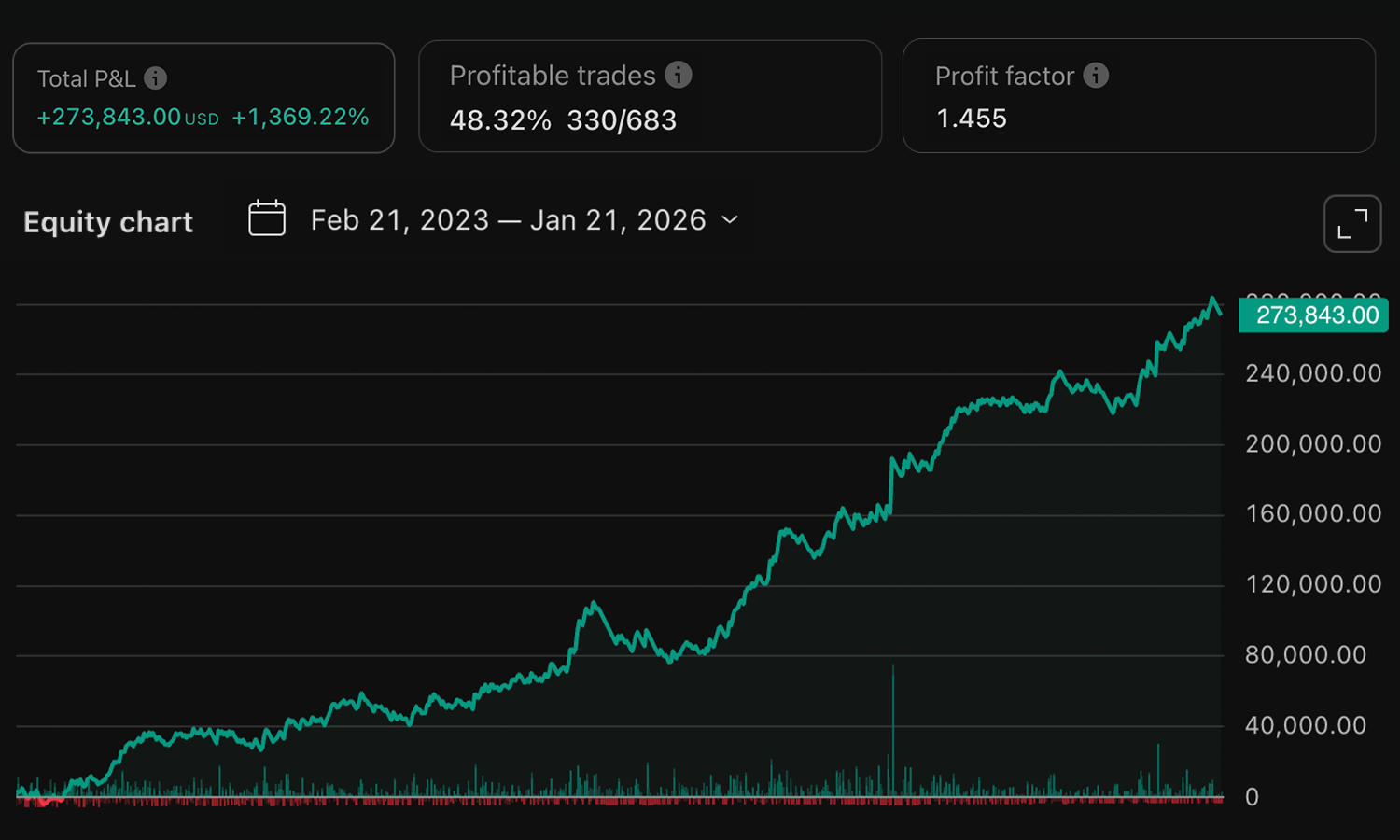
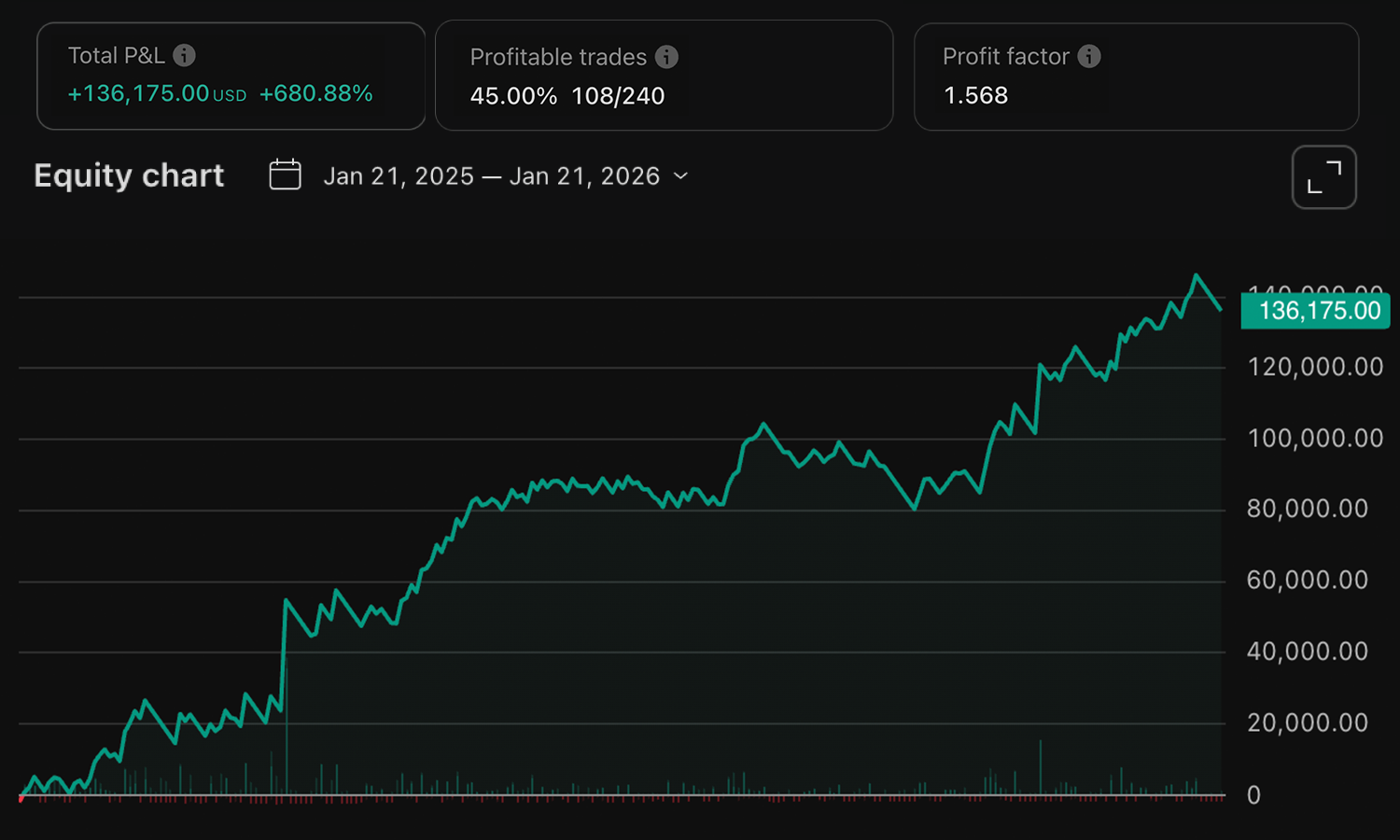
Below are the performance screenshots referenced in this overview. Review them carefully and remember: the goal is not perfect daily outcomes—it is long-run expectancy plus compounding.
3-Year Results (1 NQ, No Scaling)
1-Year Results (1 NQ, No Scaling)
Why These Results Matter
These examples were achieved without scaling contracts. That’s important because it highlights the compounding potential even at a fixed size. When scaling is done responsibly—only after significant equity growth—the compounding curve can steepen materially.
This is also why many users treat the bot like a long-term capital growth vehicle rather than a day-to-day trading hobby. The edge is in the process and the time horizon.
In the example screenshots above, the equity curve trends upward over both the 1-year and 3-year windows and the drawdowns appear relatively shallow compared to the gains. This is exactly why letting the account grow matters: as equity increases, normal drawdowns are more likely to pull back into profits rather than eating into your starting balance. That buffer is what allows compounding to work with a smoother and more consistent equity curve over time.
Execution Options: Live Brokerage vs Prop Firms
You can run this bot either on your own live brokerage account or through prop firm funded accounts. The best path depends on whether your priority is long-term compounding on personal capital or scaling across multiple accounts.
Option A: Live Broker (Recommended for Long-Term Compounding)
If your goal is to compound your own capital over time, running a live account is the cleanest long-term approach.
Recommended Brokers / Connections
- Tradeovate (commonly the easiest for setup + automation workflows)
- TradeStation
- AMP Futures
- Interactive Brokers
Live Broker Strategy (Recommended Approach)
- Be patient and let your capital grow. The objective is long-term compounding, not weekly income.
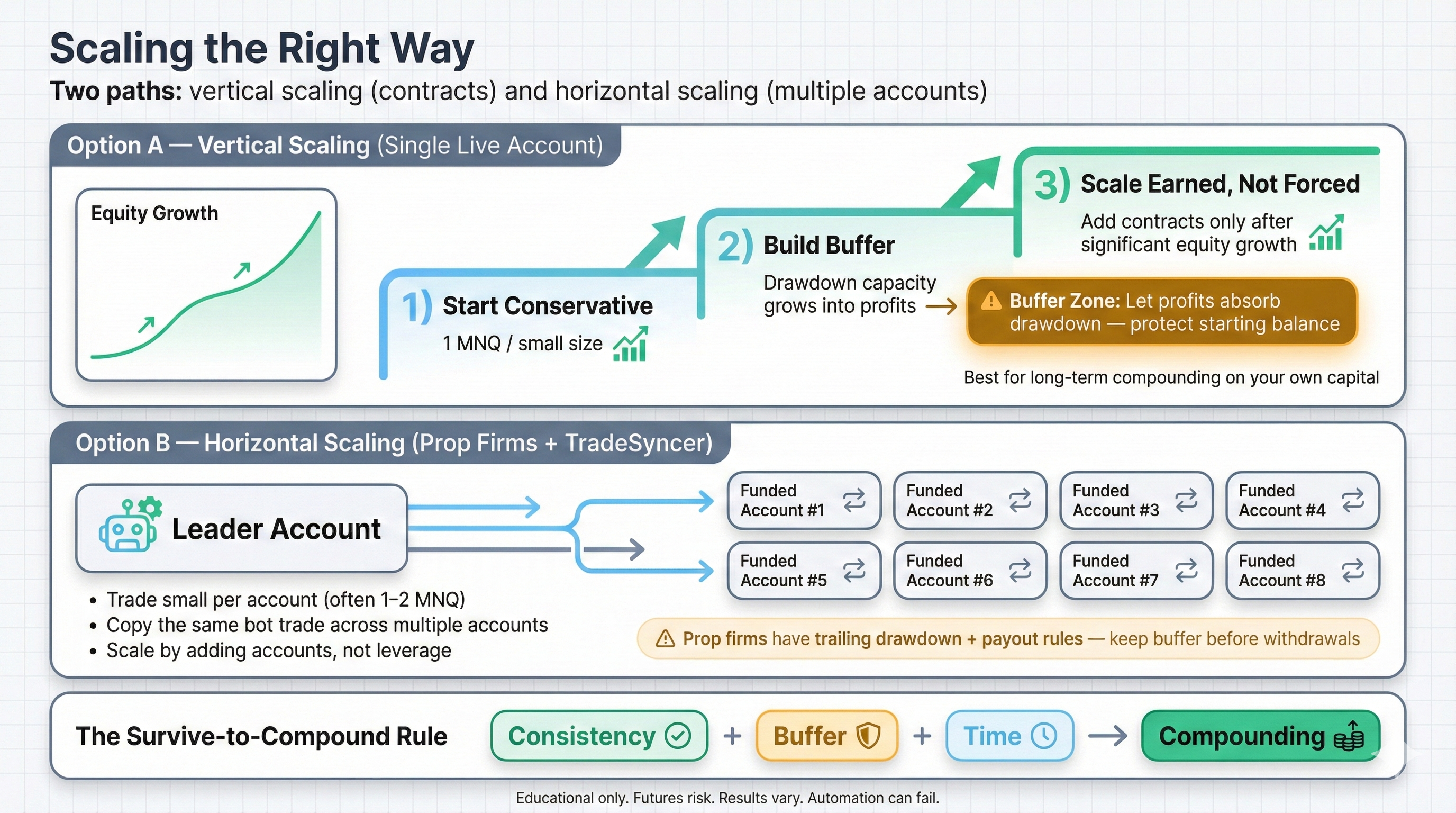
- Start conservative (MNQ for smaller balances). Scale only after meaningful equity growth and while maintaining buffer.
- Example: if you start with $25,000 and trade 1 NQ, when the account reaches $100,000 you could be trading 3–4 NQ. Compounding can accelerate significantly when scaling is earned and done safely.
Option B: Prop Firms + Copy Trading (High Leverage on Scale)
Prop firms can be a capital scaling strategy once you are funded. The disciplined approach is to pass evaluations manually first, then run automation on funded accounts with smaller size (often MNQ).
Suggested Firms
- Topstep
- Apex
- TakeProfitTrader
- Tradeify
Prop Firm Strategy (Recommended Approach)
- Pass the evaluation manually first so you are not paying monthly fees while your automation is not fully configured.
- Once funded, trade small (typically 1–2 MNQ) to reduce the risk of violating trailing drawdown rules.
- Scale the smart way: use TradeSyncer to copy the same bot trade across multiple funded accounts. This creates “horizontal scaling” instead of increasing leverage on one account.
- Only take payouts when you have room above your buffer zone so the bot can continue operating through drawdowns.
Copy Trading Note
TradeSyncer is optional, but it is the cleanest way to scale across many prop accounts without increasing risk per account. You trade small on each account and let scale do the work.
Scaling Framework
This visual shows how scaling can be done responsibly—either by increasing contracts as equity grows or by copying small size across multiple accounts.
Risk, Sizing, and the “Survive to Compound” Rule
Automation handles discipline. You handle the math. The most common reason automation fails is not the strategy—it is oversizing. If you want to treat this as a serious compounding vehicle, you must prioritize survivability.
General Drawdown Capacity Guidelines
- 1 Micro (MNQ): plan for ~$2,000+ of drawdown capacity
- 2 Micros (MNQ): plan for ~$4,000+ of drawdown capacity
- 1 Standard (NQ): plan for substantially larger buffer (commonly ~$20,000+)
These are general guidelines for survivability and will vary by broker, prop firm rules, volatility regime, and risk tolerance.
The Compounding Rule
Do not scale because you “feel confident.” Scale because your equity has grown enough to justify it while still leaving buffer. The traders who win long-term treat this like a business: controlled exposure, consistent execution, and time.
Ready to Automate MNQ/NQ?
If you want the full step-by-step implementation (TradingView alert + PickMyTrade routing + optional TradeSyncer copy trading), use the setup guide. If you want onboarding support to verify everything before going live, contact us and we’ll help you get it dialed in.
Reminder: Educational content only. Futures trading involves leverage and can result in significant losses. Past performance is not indicative of future results.